
 7 дней 1:09:23
 Rare event analysis via stochastic optimal control
Rare events such as conformational changes in biomolecules, phase transitions, and chemical reactions are central to the behavior of many physical systems, yet they are extremely difficult to study
2 118
8.5
 20 дней 47:42
 Constrained Generative AI for Materials Inverse Design
Materials inverse design aims to discover new compounds with targeted structural and functional properties, but the search space is vast and strongly constrained by chemistry and physics.
797
8.5
 29 дней 1:12:40
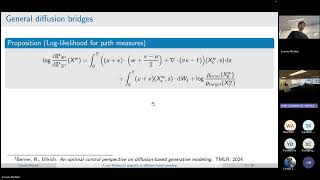
 A non-Markovian approach to diffusion-based sampling
Recently, measure transport via stochastic processes - where samples from a simple prior are evolved toward a target measure specified only by an unnormalized density - has gained significant
361
8.3
 20 дней 1:01:50
 Emerging Hardware Acceleration for Fully Homomorphic Encryption
Host: Patrick Longa, Microsoft Research Redmond Speaker: Minxuan Zhou, Illinois Institute of Technology Fully homomorphic encryption (FHE) is crucial for post-quantum privacy-preserving computing.
346
12.3
 20 дней 57:44
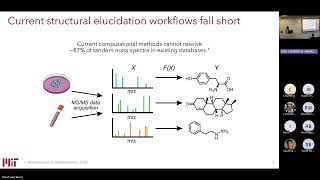
 De novo Generation for Molecular Structure Elucidation from Mass Spectrometry
Recent advances in generative AI are enabling new approaches to scientific discovery in chemistry and biology.
325
13.2
 29 дней 58:30
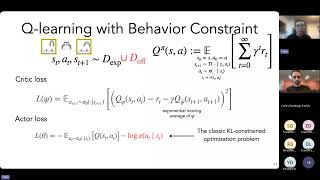
 Q-learning with Flow-Matching Policies
Expressive policies such as diffusion and flow-matching policies have recently driven progress in robotic manipulation because they can model complex action distributions and generalize from just a
269
 1 день 52:51
 Inferring Unobserved Trajectories from Multiple Temporal Snapshots
Practitioners often aim to infer an unobserved population trajectory using sample snapshots at multiple time points. E.g.
264
 29 дней 1:06:47
 Generative Models for Molecular Dynamics Across Timescales
The primary computational bottleneck in molecular dynamics is the timescale gap between the microscopic timesteps required for numerical integration and the macroscopic timescales of biological
261
 29 дней 52:55
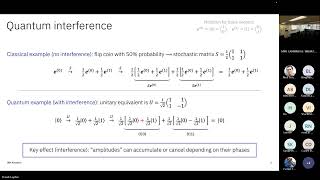
 Wavefunction Flows: Efficient Quantum Simulation of Continuous Flow Models
Continuous flow models transform Gaussian noise into samples from a learned distribution that closely approximates a complex data distribution.
227
 29 дней 59:04
 Meta Flow Maps
Controlling generative models—whether via inference-time steering or fine-tuning—is expensive. Control relies on estimating the value function—typically necessitating costly trajectory simulations.
221
 29 дней 1:20:43
 Physics and information theory of generative diffusion
Diffusion models generate structure by progressively transforming noise into data, yet the mechanisms underlying this transition remain poorly understood.
187
 29 дней 55:26
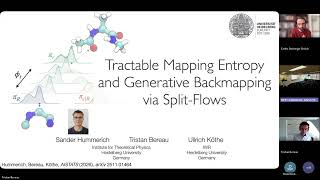
 Tractable Mapping Entropy and Generative Backmapping via Split-Flows
The transition between fine-grained and coarse-grained representations in molecular dynamics is a fundamental problem for multiscale modeling.
187
 29 дней 1:08:08
 Extending measure dynamics beyond generative modeling
Transport-based generative models, such as score-based diffusion and flow-matching, are a leading paradigm for learning complex data distributions.
159
 29 дней 40:07
 Where the Score Lives: What Wavelets Reveal About Diffusion Models
Diffusion models have had remarkable success in generating a diverse set of visually plausible images.
153
 29 дней 50:42
 Generative AI for High-Stakes Decision-Making with Applications in One Health
With rapid advances in machine learning, data-driven methods have become a powerful tool for decision making.
128
 29 дней 1:11:49
 Designing Dynamic Measure Transport for Sampling
Sampling from a target probability distribution is fundamental to modern computational science and machine learning.
125
 29 дней 43:40
 Data-Driven Discovery and Verification of Singularities in Nonlinear Partial Differential Equations
Motivated by the Clay Prize problem on the blowup of Navier-Stokes equations (NSE), I present numerical approaches that facilitate deeper insights into singularity formation, demonstrating that
121
 29 дней 51:59
 Blind denoising diffusion models and the blessings of dimensionality
We analyze, theoretically and empirically, the performance of generative diffusion models based on blind denoisers, in which the denoiser is not given the noise amplitude in either the training or
104
 29 дней 56:15
 A Unified Approach to Analysis and Design of Denoising Markov Models
Diffusion and flow-based generative models can be viewed through the lens of measure transport via Markovian stochastic dynamics, where the choice of dynamics critically shapes both theory and
81
 29 дней 44:50
 Matching features, not tokens: Energy-based fine-tuning of language models
Cross-entropy (CE) training provides dense and scalable supervision for language models, but it optimizes next-token prediction under teacher forcing rather than sequence-level behavior under model
72
20 видео