
 41 день 4:43
 Introducing GitHub Agentic Workflows: AI that runs your repo
What if your repo could run itself? GitHub Agentic Workflows bring AI agents directly into repository automation, enabling tasks to run end-to-end inside GitHub Actions.
708
25.9
 41 день 13:34
 MagenticLite: A full-stack agentic experience powered by Small Models
What if you could run a capable AI agent without leaning on frontier-scale models?
652
14.1
 41 день 44:19
 Microsoft Research Forum | Season 2, Episode 4
Microsoft Research Forum is a virtual series highlighting purposeful research and its real-world impact, from fundamental exploration to advancing AI responsibly, scaling innovation through products
700
14.2
 48 дней 43:22
 Language-Agnostic Detection of Bugs in Zero-Knowledge Proof Programs
Host: Greg Zaverucha, Microsoft Research Speaker(s): Arman Kolozyan, Max Planck Institute for Security and Privacy Zero-knowledge proofs (ZKPs) allow a prover to convince a verifier of a
400
8.6
 48 дней 3:29:16
 Language & Voice AI for Africa: From Data to Deployment and Impact
This seminar explores how language and voice AI systems can be built and scaled for African contexts—from community-driven data collection and multilingual foundation models to robust deployment and
197
 61 день 5:59
 Storycaster: An AI System for Immersive Room-based Storytelling (CHI 2026)
Storycaster transforms physical rooms into responsive storytelling environments using generative AI techniques.
1 101
10.1
 65 дней 1:01:03
 Can we AI our way to a more sustainable world?
Doug Burger, sustainability expert Amy Luers, and optimization researcher Ishai Menache examine the global emissions implications of datacenter operations, efficiency gains, and AI's potential
556
11.2
 69 дней 2:05
 Microsoft Transforms its Cloud Supply Chain with Optimization and Generative AI
Microsoft transformed its cloud supply chain with the Intelligent Fulfillment Service (IFS), a breakthrough platform that combines machine learning, mathematical optimization, and generative AI.
722
9.7
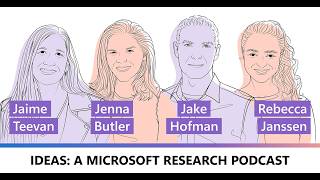 76 дней 54:26
 Ideas: Steering AI toward the work future we want
Microsoft Chief Scientist Jaime Teevan and researchers Jenna Butler, Jake Hofman, and Rebecca Janssen unpack the New Future of Work Report 2025 and explore the ideal AI-driven working world.
569
9.6
 93 дня 1:08:19
 Will machines ever be intelligent?
Technical advances are moving at such a rapid pace that it can be challenging to define the tomorrow we’re working toward.
1 370
13.1
 98 дней 0:42
 OptiMind: Microsoft Research Forum #ai #llm #agenticai #reasoning #opensource #github #slm
Register for the series: aka.ms/researchforum-register
2 257
10.4
 99 дней 0:33
 ARO: Microsoft Research Forum #ai #llm #agenticai #reasoning #opensource #github
Register for the series: aka.ms/researchforum-register
611
18.2
 100 дней 0:48
 HealthBots: Microsoft Research Forum #ai #llm #agenticai #reasoning #opensource #github
Register for the series: aka.ms/researchforum-register
1 602
23.9
 103 дня 0:43
 Agent Lightning: Microsoft Research Forum #ai #llm #agenticai #reasoning #opensource #github
Register for the series: aka.ms/researchforum-register
1 262
32
 104 дня 0:44
 Agent Lightning: Microsoft Research Forum #ai #llm #agenticai #reasoning #opensource #github
Register for the series: aka.ms/researchforum-register
1 185
32.6
 105 дней 0:38
 Magentic Marketplace: Microsoft Research Forum #ai #llm #agenticai #reasoning #opensource #github
Register for the series: aka.ms/researchforum-register
1 649
54.6
 106 дней 0:43
 Magentic Marketplace: Microsoft Research Forum #ai #llm #agenticai #reasoning #opensource #github
Register for the series: aka.ms/researchforum-register
1 551
24.3
 107 дней 0:27
 New episode: Microsoft Research Forum #ai #llm #agenticai #reasoning
Register for the series: aka.ms/researchforum-register
1 760
48.6
 110 дней 52:29
 CROSS — Leveraging AI ASICs for Homomorphic Encryption
Artificial Intelligence (AI) is driving a new industrial revolution, transforming human workflows increasingly into digital tokens, i.e., tokenizing the entire world.
526
9.9
 110 дней 56:20
 Efficient Distributed Orthonormal Optimizers for Large-Scale Training
Speaker: Kwangjun Ahn, Microsoft Research I delivered a 50-minute technical talk on recent advances in orthonormal update methods for large-scale AI model training.
686
8.4
 113 дней 1:21:45
 Bridging Neurotechnology with Immersive Systems: Getting BCIs outside of the lab?
Brain-Computer Interfaces (BCIs) are moving beyond their original and main applications as rehabilitation technologies, to become promising tools for interacting with users by measuring their mental
391
11.5
 113 дней 1:03
 New episode: Microsoft Research Forum
Register for the series: aka.ms/researchforum-register
1 603
29.3
 113 дней 6:42
 Dion2: A new simple method to shrink matrix in Muon
Dion2 reduces the cost of Muon’s orthonormalization step by orthonormalizing only a small, selected submatrix at each iteration.
1 767
14
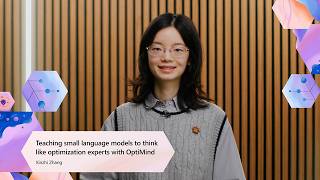 113 дней 7:55
 OptiMind: Teaching small language models to think like optimization experts
OptiMind is a specialized language model that translates natural-language problem descriptions directly into solver-ready mathematical optimization formulations.
1 250
7
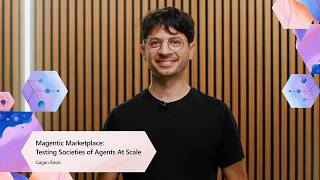 113 дней 6:20
 Magentic Marketplace: Testing societies of agents at scale
As AI agents move from isolated tools to active participants in multi-agent ecosystems, their success depends on more than task competence—it requires strategic behavior under misaligned incentives
421
19.7
 113 дней 6:30
 Agent Lightning: One learning system that makes all agents evolve
Agent Lightning is an agent optimization framework that enables agents to learn from their experiences through reinforcement learning and other methods.
587
10
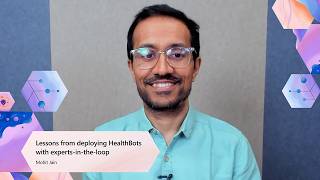 113 дней 9:55
 Lessons from deploying HealthBots with experts-in-the-loop
HealthBots pair LLMs with rapid expert verification to deliver trusted medical guidance at scale.
179
 113 дней 8:37
 ARO: A new lens on matrix optimization for LLMs
We present Adaptively Rotated Optimization (ARO), a matrix optimizer that speeds up LLM training by applying updates in a rotated, geometry-aware coordinate system.
234
 113 дней 48:08
 Microsoft Research Forum | Season 2, Episode 3
Microsoft Research Forum is a virtual series highlighting purposeful research and its real-world impact, from fundamental exploration to advancing AI responsibly, scaling innovation through products
893
13.8
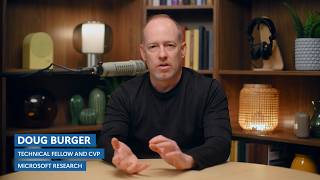 113 дней 1:27
 Trailer: The Shape of Things to Come
Technical advances are moving at such a rapid pace that it can be challenging to define the tomorrow we’re working toward.
728
11.8